When a mission depends on aircraft, operators, digital services, ground infrastructure, and several organizations, no participant controls the whole operation. An architecture that describes each component separately may explain the parts while obscuring whether the mission can still succeed. The Unified Architecture Framework (UAF) addresses this problem by connecting strategy, operations, services, resources, people, standards, and requirements in one model.
That promise is bigger than producing a consistent set of diagrams. UAF can give customers, suppliers, operators, and engineering disciplines a shared vocabulary for the architecture. The model can show both the mission-level purpose and the resources that implement it. But can UAF bring order to that complexity without creating more of it? The answer depends less on the grid of available views than on how the organization governs the model behind them.

UAF as a Common Architecture Language
UAF is an OMG standard for describing enterprise architectures through a shared set of concepts and relationships. Its Domain Metamodel defines what those concepts mean, while UAFML provides a UML/SysML-based way to represent them in modeling tools. The current specification is UAF 1.3.
That common language matters when several organizations contribute to the same mission. Instead of reconciling disconnected documents and local vocabularies, customers and contractors can work from the same architecture and trace mission needs into operational and technical choices. UAF can reduce ambiguity and facilitate model exchange, but it neither replaces contractual requirements nor guarantees lossless transfer between tools.
Many Views, but One Connected Model
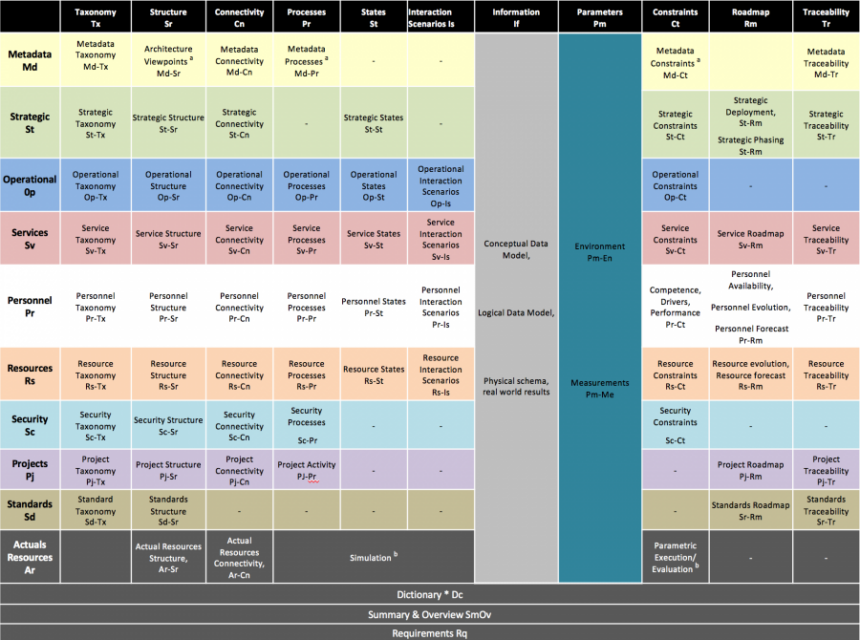
The UAF grid can seem intimidating, but its organizing principle is straightforward. Each row is a domain: a part of the underlying information model such as Strategic, Operational, Services, Personnel, Resources, Security, Projects, or Standards. Each column is a model kind: a standard way to present information through a taxonomy, structure, connectivity, process, state, interaction scenario, information model, parameter, constraint, roadmap, or traceability representation. Their intersections are view specifications, also described as viewpoints.
The Grid Presents and the Model Connects
The UAF Wiki makes an important distinction between information and presentation. Domains describe different parts of the information model, while model kinds provide standard ways to represent that information for stakeholder concerns. Views are therefore artifacts extracted from an integrated architecture description, not separate stores of truth. The flat grid catalogs those presentations, but it does not show how the information behind its cells is interrelated.
Treat the grid as a menu, not a checklist every project must complete. An architecture team should select views because they answer a stakeholder concern or support a decision. A cross-organizational airport or urban air mobility mission may require more views than a bounded product architecture.
Beneath those views lies the real value. Each view should expose a relevant projection of the same connected model rather than create an independent diagram with duplicated content.
From Architecture to Decision: An Airport Example
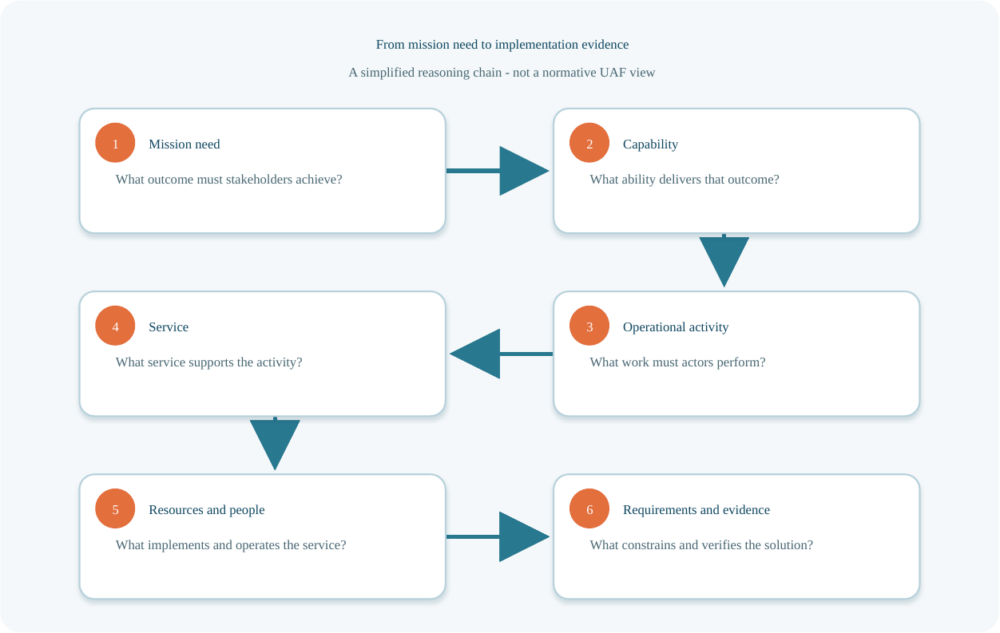
Consider a simplified airport or urban air mobility operation that depends on a surveillance-processing node. In grid terms, safe traffic coordination is a Strategic capability, while managing aircraft separation is an Operational activity. A tracking service belongs to the Services domain; its processing function, node, and operators form part of the Resources and Personnel domains. Requirements span the grid, while Parameters and Constraints can capture availability, latency, coverage, and integrity. Together, these views define the evidence needed to accept the implementation.
Now suppose the processing node becomes unavailable. In a collection of independent diagrams, an engineer may see where the node sits without knowing the mission-level consequence. In a connected architecture, the team can follow its relationships upward. It can identify which services are lost, which activities become degraded, which capabilities and missions are affected, and which requirements are no longer satisfied.
The team can also trace possible responses downward. Could the service move to a secondary resource? Can another surveillance source provide enough coverage? Would reduced traffic capacity keep the operation inside its safety and performance constraints? If not, which mission or operational mode must be suspended? Each alternative can be assessed against the same architectural chain instead of being discussed as an isolated equipment change.
UAF does not choose the answer. It makes the assumptions, dependencies, and affected stakeholders visible enough for specialists to evaluate them. The safety team can then connect the degraded function to hazards and safety evidence, following the same principle described in Anzen’s articles on Model-Based Safety Analysis and model-based Bow Tie analysis.
Where UAF Reaches Its Limits
A standard is not a methodology
UAF defines concepts, relationships, and views, but it does not prescribe the sequence in which a team must build the model. It does not assign ownership, establish maturity gates, or define what “complete enough” means for a project. Organizations still need a methodology, modeling conventions, review criteria, and a clear definition of which decisions the architecture must support. This separation between language, tool, visualization, and methodology is also important when implementing domain-specific workflows in Cameo.
Interoperability is not automatic
Shared semantics make exchange more realistic, but two UAF tools may support different parts of the specification or represent extensions differently. A credible exchange strategy needs agreed versions, stable identifiers, controlled profiles, reference data, and round-trip tests. Without those controls, teams can comply with the same high-level standard while still losing relationships or meaning between environments.
A connected model demands governance
The value of UAF diminishes when teams duplicate elements, leave relationships stale, or cannot identify the authoritative source. Configuration control, baselines, change management, and model ownership are therefore part of the engineering effort. A model can also be internally coherent and still rest on incorrect assumptions. Connection improves impact analysis; it does not turn the repository into verified truth.
The cost must match the decisions
UAF is broader than every project needs. Completing views simply because they appear in the grid consumes effort without necessarily increasing understanding. The architecture team should start from stakeholder concerns and decision needs, then select the smallest coherent set of concepts and views that supports them. Training and tailoring still require investment, so the expected traceability and collaboration benefits must justify that cost.
When Is UAF Worth Using?
UAF is easiest to justify when a mission crosses organizational boundaries or several stakeholders need different views of the same architecture. It is also valuable when changes must be traced from strategic goals to implementation and evidence, or when architecture information must survive a long lifecycle and move between teams and tools.
A simpler SysML, Capella, or domain-specific model may be enough for a bounded product with a small team and limited exchange needs. The choice is not between adopting every part of UAF and having no architecture at all. It is about selecting the smallest architectural framework that preserves the relationships needed to make and revisit important decisions.
Final Takeaway
UAF’s central promise is a shared semantic model connecting mission purpose, capabilities, activities, services, resources, and requirements. Its central limitation is that the standard cannot maintain those connections, validate their assumptions, or govern their owners.
The practical next step is to decide which relationships must remain authoritative and which decisions they need to support. Anzen can help scope and tailor that architecture, then connect it to systems engineering, safety analysis, and verification evidence without turning the UAF grid into a completion exercise.
UAF’s promise is not to eliminate complexity. It is to make complexity visible, navigable, and open to discussion before its consequences appear in the real world.
About the authors
Amin Y. Elamin Moreno is an aeronautical engineer specializing in systems engineering and MBSE integration for complex aerospace projects.
At Anzen, he oversees the design and development of MBSE solutions, ensuring that architectures are consistently integrated into systems engineering workflows, while supervising their implementation and supporting the continuous improvement of model-based engineering practices.